Call of Cthulhu handouts: three clues for an original investigation
Create Call of Cthulhu handouts using an original newspaper clipping, diary page and cargo receipt, with practical leads and notes for the Keeper.
Call of Cthulhu handouts can begin as ordinary documents with one detail that does not fit. An impossible time, a repeated signature or a shipment with no clear origin invites investigators to compare evidence. A creature does not need to appear on the first page to create unease.
This guide provides three original texts for an investigation in a fictional port town in 1926. They do not reproduce handouts from published adventures and can be adapted to other investigative RPGs. Lay them out with the RPG handout maker.
The case: a delivery at an abandoned lighthouse
Keeper preparation: someone is using the old lighthouse to receive objects recovered from the seabed. A clerk disappeared after discovering that a shipment would be collected before dawn. The players need to find the location and decide how to approach the next delivery.
The documents point toward the same location through different leads. Introduce them in response to the group's actions: searching archives, visiting the missing clerk's home or inspecting the docks. They do not require a fixed reading order.
Handout 1: newspaper clipping
GREYHARBOR GAZETTE — October 17, 1926 Lighthouse lights interrupt search for missing clerk Searchers looking for clerk Arthur Vale reported an intermittent light at the old lighthouse early yesterday morning. The building has had no electrical supply since March. The port authority attributes the light to passing vessels. Leonor Campos, a watchkeeper at pier three, says she saw a cart take the maintenance road at two in the morning.
Usable leads: the lighthouse, maintenance road, time and a named witness. Open question: who is producing the light? Possible next scene: speak to Leonor or examine the approach to the building.
The report records conflicting accounts without deciding which is true. Investigators can establish that themselves. See the RPG newspaper guide for a readable clipping layout.
Handout 2: diary page
October 15 Counted the shipment again. Six crates on the receipt, seven in the warehouse. The last has no nails, hinges or lid. The supervisor told me to correct the record but would not say which number was wrong. October 16 Tomorrow, two in the morning, old lighthouse. If I do not return, find Leonor. She saw who brought the seventh crate. Do not tell her I kept the receipt inside the atlas.
Usable leads: a coming delivery, the watchkeeper's name and the location of another document. Horror detail: the crate with no opening. Arthur records observations without explaining what the object actually is.
Use two short entries and consistent margins. Do not obscure “two in the morning” with a stain. If handwriting becomes tiring to read, use it only for the signature.
Handout 3: cargo record
NORTH COAST WAREHOUSE — receipt 0417 Arrival: October 15, 1926. Declared packages: 6. Origin: maritime recovery. Destination: old lighthouse station. Collection scheduled: October 18, 02:00. Inspection clerk: A. Vale. Handwritten note: “Do not open in transit. Excess package travels separately.”
Usable leads: confirmation of the destination and collection time. Discrepancy: the October 16 diary entry predicts a delivery on the 17th, but the receipt names the 18th. Decide before play whether it was postponed or whether there are two deliveries. Give the investigators a way to clarify this with warehouse staff.
Keep the investigation moving
Each document provides a place, person or action. If the group misses the diary, the newspaper still points to Leonor and the lighthouse. If they misread the schedule, the watchkeeper can explain the dock routine. An essential discovery should not depend entirely on solving one puzzle.
Keep these Keeper notes separate from the player-facing text. Use neutral filenames, preserve a transcript and release only the documents the group discovers. Check margins for print and phone readability for online play.
Can these handouts work in a modern paranormal game?
Yes. These examples contain no game mechanics. Replace the printed newspaper with a local news post, the receipt with a logistics record and the dates with your campaign's period. The connections between the clues remain useful.
For more documents, follow the RPG handout creation guide and letter and diary examples. If you are choosing a tool, read the Cthulhu Architect comparison.
Try editable documents
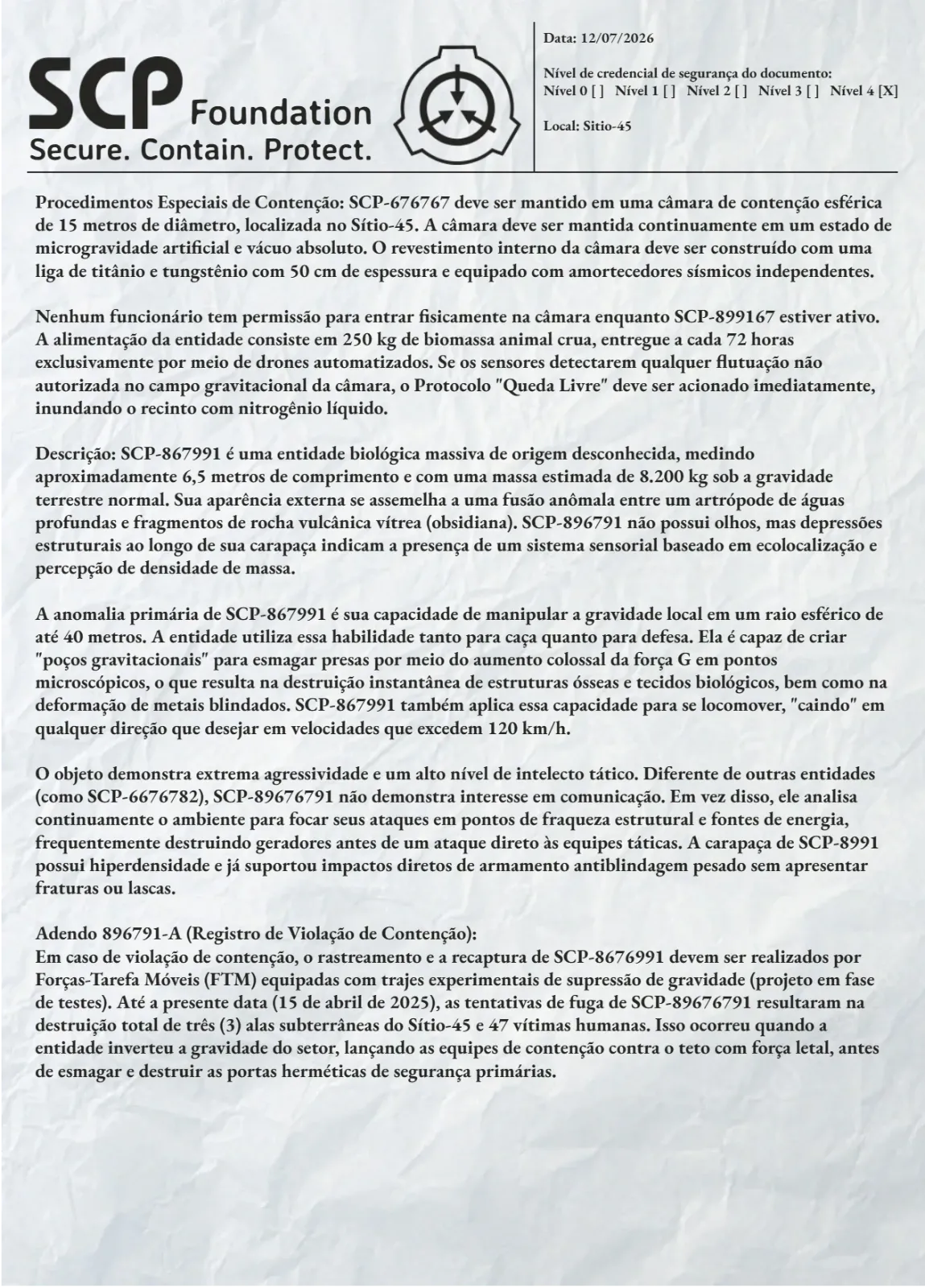
Choose a format in the template collection or open Relatório da Fundação. The image above previews the existing catalog template, which uses SCP Foundation references. For Call of Cthulhu, adapt its text, symbols and images to your story’s institution and period. Check its access conditions before editing.